Girls on the Go

This past summer, three colleagues (all females) and I (a male) organized and hosted a summer camp aimed at attracting female students into computer science and other technology-based careers. The target audience for our camp was rising sophomores and juniors in high school and focused upon the entire college experience – not just technical knowledge.

Computer science and other technology-based programs across the nation have seen a gradual decrease in enrollment by female students from about 18% in 1994-95 [1] (the first year that the Taulbee survey reports on bachelor’s degrees by gender), to about 11% now [2]. In my department at Miami, our enrollment numbers reflect the national average – only 11% of the computing students (computer science, software engineering, and engineering management/systems analysis) are female. In terms of raw numbers, this is only 29 of 265 students. Worse yet, the number of students we expect to award degrees to is 7 of 69 (less than 10%).

To help you all understand how bad things are, let’s look at my courses where the rubber hits the road – I am teaching two courses in computer science at the moment: software architecture and design, and client-server architectures. Of the total 34 students enrolled in these courses (there are 17 in each), 1 is female. I also coordinate the senior design course in our department where the picture is nearly as bleak – 3 of 31 students are female. A colleague of mine from Arizona State University shared the following numbers: 0 of 29 in a software enterprise course, 1 of 13 in a web development course, 1 of 26 in a freshman computing course. These numbers are beyond shocking.

This data seems to beg the question of how we got here in the first place. What is it exactly about computing that makes it so unattractive to females? I have heard that a number of factors point to why this is the case, including a lack of role models, misconceptions about the careers of graduates, fear that computer science students work mostly in isolation, and a general sense that computer science is mostly about hacking or developing and playing games. Is there a reason why these stereotypes arose?

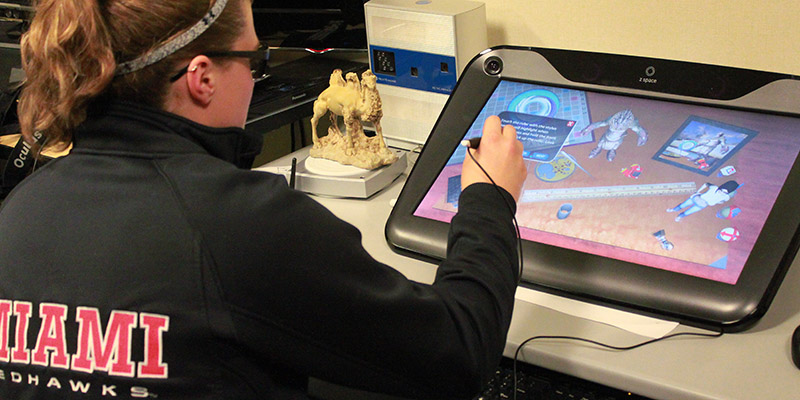
To help dispel these misconceptions and to provide a balanced look at the life of a computer science student, we focused our summer camp on three goals: we wanted the camp to be relevant, we wanted the camp to be realistic, and we wanted the camp to be residential. In being relevant, we focused on providing students access to aspects of computing that go beyond just designing and playing games. As such, students spent the week learning about developing mobile apps for the domain of ethology (e.g., the study of animal behavior). In being realistic, we focused on providing students with a broad view of the app development lifecycle. As such, students were involved in learning about and specifying requirements, designing apps from the ground up by creating mockups, and the writing of apps using leading-edge development tools. In being residential, the camp focused on educating students about campus life. Students lived in the dorms for the week, ate in the dining halls, interacted with each other in social settings, and, in some small part, received a taste of living the life of a college student.

At our camp, three of the four instructors were female. In addition, we employed four female Computer Science/Information Technology students as counselors. Finally, we invited female IT professionals for a career mentoring event one evening. The week was a great success. Our pre-post surveys showed a statistically significant effect on the knowledge of computing as a discipline and on the confidence levels for pursuing computing degrees by the campers. We have used the momentum gained from the camp to enlist many of the campers to continue to work on the app we began in the summer, and hope to use this model to increase our yield of students enrolling in computing, interactive media studies, and information technology.

So, now what? As a call to action to all of you, we are interested in raising support of all kinds, from monetary to in-kind and from ideas about future camp themes to donations of time. Indeed, while there are other programs out there like the xCWIC programs (e.g., the name your region Celebration of Women in Computing) and NCWIT (National Center for Women & Information Technology), we believe we’ve hit on something that makes the act of recruiting students to IT more personal.

[1] As a percentage of degrees awarded. From Andrews, G. 1995 CRA Taulbee Survey, March 1996, Computing Research News.
[2] As a percentage of degrees awarded. From Zweben, S. Computing Degree and Enrollment Trends: from the 2010-2012 CRA Taulbee Survey, Computing Research Association.

Enhanced by Zemanta

Tags: , ,

Leave a Reply