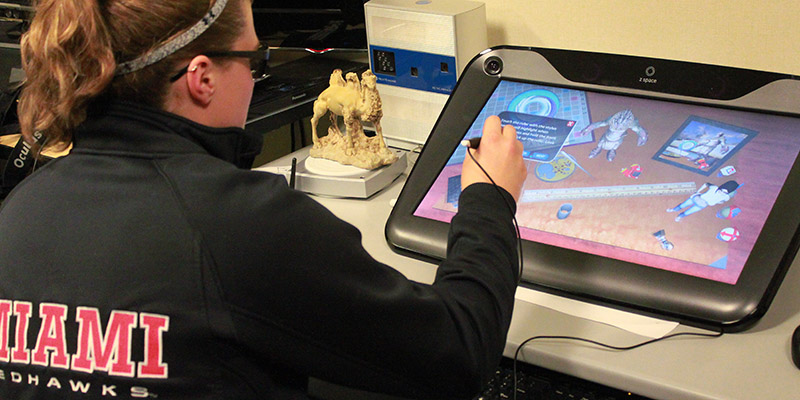
Keiko and Lucas Pope's Mightier, a game featured at Indiecade. (Mel Melcon / Los Angeles Times / September 28, 2009)
Last week was the inaugural (and hopefully first annual) Indiecade independent games festival in Culver City, California, bringing together game designers, games educators, and games journalists for what the LA Times called “the video games industry’s Sundance.” Unfortunately, I couldn’t attend, but it’s been the talk of the indie gaming community in the past week. Over at the (lamentably now shuttered) Offworld, Brandon Boyer encouraged readers to attend in a great, three-part preview of the festival: “Why I’m Going to Indiecade (and You Probably Should, Too),” part 1, part 2, and part 3.
One of the highlights was a fascinating talk between Robin Hunicke (Boom Blox), Keita Takahashi (Katamari Damacy), and Jenova Chen (Flower) on wacky ways to reinvent first-person shooters. Ideas between these three designers and the audience participants ranged from simple changes in game mechanics (shrinking the player as he or she progressed), to new ways of including emotional experiences (beyond suspense), and genre-bending settings (such as “shooting” musical notes to an orchestra). As the world of indie gaming grows, it becomes clear that the industry needs more of these kinds of discussions and these kinds of festivals, while we, as games researchers, need to better understand the new possibilities for interactivity that are arising out of these indie gaming communities.
Looking back at Glenn’s recent post, when we think about the “interactivity” of games, we need to pay increasing attention to the things that indie games often do best that actually have little to do with technology per se — seeing games as interactive metaphor, games as systems to create emotional experiences, and games as toolboxes for play. These are issues that are increasingly gaining traction in indie game design, and are being reported on by some international media, as this appearance by Passage‘s Jason Rohrer and Chris Crawford on Game Design‘s Chris Crawford on the French/German television series Into the Night recently showed.
Preparing students to become “games professionals” doesn’t mean the same thing it did ten years ago, or even five years ago. Understanding how indie games requires us to reposition games as more than entertainment and start to see them for the evolving, interactive, communicative media that they are is the task ahead.


After reading this post and the post on “interactivity” I began thinking about my own gaming experiences. When playing a video game I always find the games that I enjoy the most are the one’s that draw me completely into the gaming experience. You forget the world around you and the game becomes your world. I think this relates to this article and interactivity. If a game can become so interactive that we become immersed in it then the game is not only a goal orriented activity, but rather draws the player in because they want to see how their individual experience will be in a new interactive world.
Thanks for the comment — I definitely agree, we need to better understand the ways that games serve not just as simple designer-imposed, goal-oriented activities, but work as “worlds” that players inhabit and imbue with their own goals and desires. The play “around” games (everything from employing cheats through modding of games) needs to be part of this discussion, as interactivity with games is rarely simply the achievement of the in-game goals.
Interesting quick read, Sean.
I do not think it’s helpful to look at indie games in a 3rd person perspective. If the lunatic fringe of creativity and boundary pushing is referred to as “independent”, then the inner mass of “mainstream” or “commercial” games must conversely be called dependent games. Now we have to ask — dependent on what? People buying them? Dependent on a safe, marketable balance between “new” and “old”? Dependent on the independent? Either way, this is where the binary view falls apart.
Indie games and mainstream commercial games (again I apologize for over-simplifying) are utterly co-dependent. This is nothing new, we’re all aware of the filtering process that a weird convention-bucking (“indie”) idea undergoes on its way to mainstream/popular acceptance. Ideas iteratively get dumbed down to become stomach-able until it is accepted by that critical mass… who, in turn, go buy it. The metaphor works well with fine-art and culture as a whole (look at the irony of avant-garde becoming filtered into popular style, commercialized counter-culture). We need finer granularity than “indie and not-indie”, “dependent or independent”.
So I only partially agree that “we need to pay increasing attention to the things that indie games do best”. I suggest instead: we need to pay increasing attention to the things that games do best, and examine the context and reasons for those successes. The phenomenon Sean mentioned regarding sandbox “world” play, breakdown of designer-player (creator-consumer) relationship, the games “around” games (meta-gaming, affinity groups and external) — we find instances of these across the entire genre spectrum, in “not-indie” games (The Sims, WoW, Everquest, Little Big Planet) as well as “indie” niche ones (dating simulators, seemingly classification-defying games like Flower, Limbo).
woah… sorry for writing a novel in my last comment
Ryan, I’m not sure what you mean by a “3rd person perspective” here — I’m necessarily looking at it from that perspective, as I am neither a commercial nor indie game designer. Yet, still very invested in the success of the indie gaming world for various reasons.
You state: “We need finer granularity than “indie and not-indie”, “dependent or independent” — I completely agree with this, and was not trying to support a strictly binary view. Of course, “indie” and “non-indie” are ends of a continuum, with a number of games/game studios/game designers occupying that middle space.
That said, we can’t ignore the role that financial concerns play in defining what even “counts” as a game in the current game industry. At GDC, the indie games summit and IGF competition featured a much wider range of game visual styles, innovative game mechanics, and attempts to bridge games into “art” rather than simple commerce. And, of course, developers who have relatively little power in the industry and are constantly strapped for funds.
But, it’s that difference of *intent* that is important — discussions of games as medium and games as an art form seems to be more supported in the indie games world than in the commercial games world. And while it’s clear that the indie games world often needs and relies on the commercial game world (the 8-bit aesthetic of many modern indie games wouldn’t even exist if not for the 8-bit commercial games of a previous era), the indie folks don’t expect to become gazillionaires off of their games (at least, the smart ones don’t), and thus we see perhaps a bit more interest in explorations of game form and mechanics than you could see in a AAA title.
So, my concern is for understanding interaction, learning, and design in these spaces. The commercial space is much, much less interesting (and much, much more opaque) than what’s going on in the indie space these days.
Thanks for your comments.